How to Use a Family Schedule App for Teens to Build Independence and Reduce Mental Load
How a shared family schedule app helps teens manage their own calendars, build independence, and take pressure off parents.
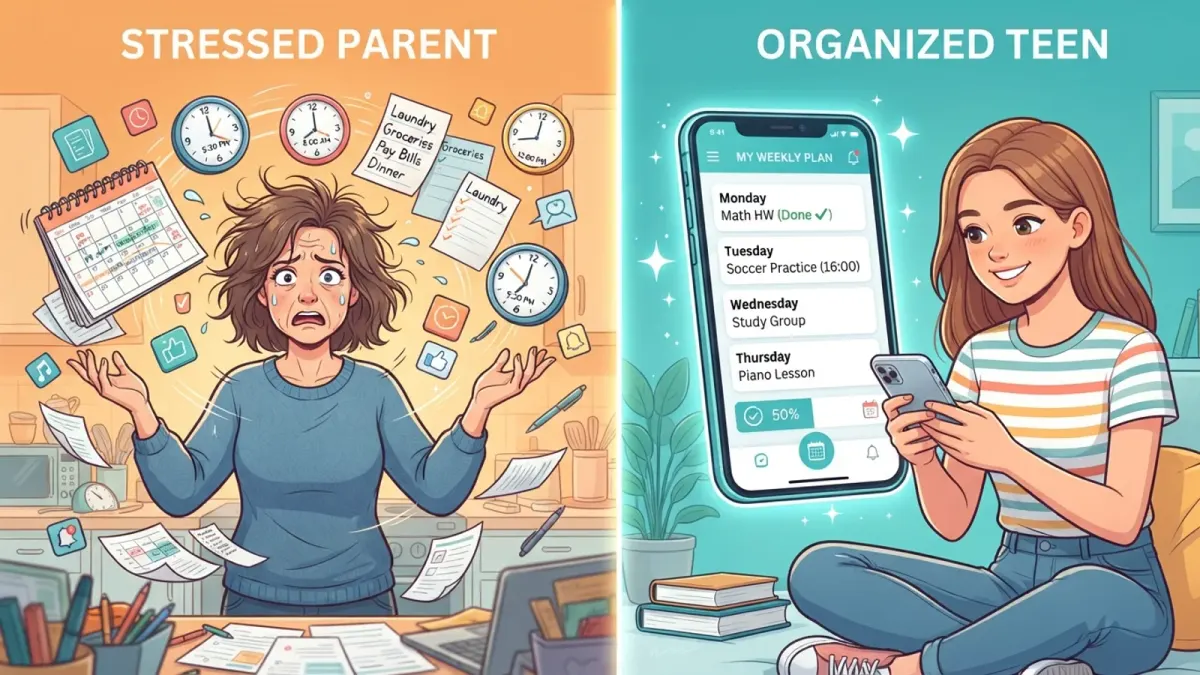
To get teenagers to manage their own schedules and chores, parents must shift from acting as the household’s personal assistant to providing a structured digital training ground. If you are exhausted by the endless loop of “What’s for dinner?” and “What time is my game?”, the solution isn’t to try and remember better—it’s to stop being the memory for everyone else. By using a family schedule app for teens, like the Home Run AI family organizer, you can transfer daily logistics out of your head and into a centralized system. This allows teens to practice vital executive functioning skills independently while drastically reducing the default parent’s family mental load.
The Teenage Brain Under Construction: Why Independence Requires a System
The Frontal Lobe Factor
It is incredibly frustrating when a highly intelligent teenager forgets their track cleats for the third time in a week or fails to start a history project until the night before it is due. However, this forgetfulness is not necessarily a sign of defiance or laziness; it is a matter of biology. The human brain’s frontal lobe—the region responsible for executive functioning skills such as planning, prioritizing, and working memory—does not fully develop until a person reaches their mid-20s. Expecting a middle or high schooler to flawlessly juggle academic deadlines, extracurricular activities, and household chores using only their internal memory is setting them up for failure. Their brains simply do not have the hardware yet.
Instead of viewing their disorganization as a character flaw, parents should see it as a developmental stage that requires external support. A family task management app acts as a necessary “prosthetic” for their growing brains, providing the structural framework they need to keep track of their responsibilities while their frontal lobe continues to mature.
Scaffolding Over Nagging
When teens inevitably drop the ball, the default parental response is often verbal reminding—which teenagers universally interpret as nagging. This dynamic creates immense friction in the household and, worse, it fails to teach self-reliance. When you act as their alarm clock and calendar, they have no incentive to develop their own time management skills.
The alternative is “scaffolding”: providing a temporary, supportive structure that helps a child achieve a goal they cannot quite reach on their own. By introducing a centralized digital tool, you offer a safe environment for teens to practice autonomy. A family schedule app for teens replaces the emotionally charged voice of a frustrated parent with a neutral, objective system. When the app sends a notification that it is time to take out the recycling, it removes the interpersonal conflict. The teen learns to respond to their own schedule rather than reacting to your prompts, gradually building the independence they will need in adulthood.
Resigning as the ‘Default Parent’ to Save Your Sanity
The $3.8 Trillion Invisible Job
The unseen architecture of family life—remembering permission slips, anticipating growth spurts, planning meals around soccer practice, and tracking the household inventory of toilet paper—requires an astonishing amount of cognitive labor. This family mental load is relentless, invisible, and entirely uncompensated. To put the sheer scale of this work into perspective, if U.S. parents were financially compensated for the unseen labor involved in managing a household with children, it would equate to roughly $3.8 trillion in economic value.
You are essentially working a high-stakes, full-time logistics job on top of your actual career and parenting duties. Acknowledging this economic reality is the first step toward validating your exhaustion. You are not tired because you are failing at time management; you are tired because you are single-handedly operating a complex organization without the proper enterprise software. Transitioning to a family operating system is not a luxury—it is a critical step for your own well-being.
Breaking the Dependency Loop
Despite decades of progress toward gender equality in the workplace, the invisible work of household management remains stubbornly lopsided at home. The burden of the family mental load falls disproportionately on mothers, with employed fathers reporting 29% less responsibility for these cognitive tasks. This imbalance creates a dependency loop: because Mom knows where everything is and what everyone is doing, everyone defaults to asking Mom.
To break the “Ask Mom” reflex, you must democratize the household information. You cannot effectively share household responsibilities if you are the only one holding the master schedule in your head. By migrating the family calendar, chore charts, and meal plans into a shared digital space, you remove yourself as the bottleneck. When a teenager asks, “What time are we leaving?”, the new default answer becomes, “Check the app.” This simple redirection forces family members to consult the system, slowly dismantling the dependency loop and distributing the cognitive weight more evenly across the household.
Building a Digital Training Ground with Home Run
Centralizing the Truth
For a teenager to take ownership of their time, they need access to the complete picture. Home Run operates as a private family AI operating system, serving as the single source of truth for your household’s logistics. Unlike a whiteboard on the fridge that only shows a fraction of the week, or a fragmented text thread that gets lost in the noise, Home Run centralizes everything. Meals, rides, appointments, and chores live in one secure, accessible digital dashboard.
This transparency is crucial for building executive functioning. When a teen can open their family schedule app for teens and see that they have a dentist appointment at 4:00 PM and that it is their night to load the dishwasher, they can begin to anticipate their day. They learn to connect the dots—realizing they need to finish their homework before the appointment because they will not have time afterward. You are no longer gatekeeping their schedule; you are empowering them to navigate it.
Automating the Accountability
One of the most exhausting aspects of delegating tasks is the follow-up. Assigning a chore is only 10% of the work; the other 90% is monitoring whether it was completed and issuing reminders when it wasn’t. Home Run acts as an AI family organizer that takes over the role of taskmaster.
By automating the accountability, the system prompts your teen about their upcoming responsibilities. If the dog needs to be walked at 5:00 PM, the app delivers the nudge. This shifts the dynamic from parent-versus-teen to teen-versus-task. The AI handles the logistical nagging, allowing you to preserve your energy for actual parenting—connecting, listening, and guiding. Furthermore, because the system tracks completion, there is no longer a debate about whether a chore was done. The objective data is right there in the app, providing clear accountability without the emotional baggage of a lecture.
4 Steps to Successfully Delegate Household Chores to Your Teen
Step 1: Co-Create the Roster
Do not simply hand down a mandate from on high. If you want your teenager to buy into a new family task management app, they need to be involved in its creation. Sit down together and input their weekly commitments—school hours, sports, part-time jobs, and social events. Once their baseline schedule is visible, discuss and assign specific chores within the app. Allowing them to choose between vacuuming the living room or folding the laundry gives them a sense of agency. When they have a hand in building the roster, they are far more likely to respect it.
Step 2: Define ‘Done’
A common source of conflict when you delegate household chores is a mismatched expectation of what “finished” looks like. To a teenager, cleaning the kitchen might mean putting their cereal bowl in the sink. To you, it means wiping the counters, loading the dishwasher, and sweeping the floor. Use the app’s notes or checklist features to explicitly define the parameters of a completed task. Break down “Clean Bathroom” into a micro-checklist: wipe mirror, scrub toilet, empty trash. Clear expectations eliminate loopholes and set your teen up for success.
Step 3: Establish the Daily Sync
A tool is only effective if it is used consistently. Help your teen build the habit of checking their digital dashboard by establishing a “Daily Sync.” This should be a brief, two-minute routine anchored to an existing habit—such as right after they brush their teeth in the morning or right before they plug their phone in at night. During this sync, they review what is on their plate for the next 24 hours. Over time, this daily review strengthens their working memory and planning skills, turning a forced habit into second nature.
Step 4: Step Back and Allow Natural Consequences
This is often the most difficult step for parents. Once the system is running, you must step back and let it work. If your teen ignores the app and forgets to wash their uniform, do not rush in to do a midnight load of laundry. Allow them to experience the natural consequence of wearing a dirty uniform to practice. For a digital training ground to be effective, it must include the safety to fail. Rescuing them undermines the system and reinforces their dependency on you. Let the app manage the schedule, let the consequences be the teacher, and watch their independence grow.
Conclusion
Transitioning your household from a parent-managed logistics center to a shared ecosystem is one of the most impactful changes you can make for your family’s well-being. By providing your teenager with a structured digital training ground, you are giving them the tools they need to build essential executive functioning skills for adulthood. At the same time, you are reclaiming your own mental space and energy. Download the Home Run app today to set up your family’s private operating system, invite your teen to their new digital dashboard, and take your first step toward retiring as the household’s default personal assistant.