How to Stop the After-School Meltdown: Build a Low-Demand, AI-Guided Routine
Replace the fridge checklist with a low-demand, AI-guided after-school routine that helps kids decompress, snack, and start homework without nagging.

You walk through the front door, backpacks dragging, shoes discarded in the middle of the hallway. You want to hear about their day, and you certainly want them to get started on their homework so the evening isn’t a rushed scramble. You point to the colorful, laminated after school routine checklist stuck to the refrigerator. “Shoes in the cubby, backpack emptied, homework started,” you remind them.
Instead of cooperation, you get a door slam, a flood of tears, or an immediate attitude flare-up.
This is the daily reality for millions of parents. The traditional, paper-based after school routine checklist often fails because it demands constant parental monitoring, transforming exhausted parents into nagging enforcers. To successfully navigate the transition from school to home without triggering afternoon meltdowns, families need a dynamic, low-demand system. By leveraging Home Run’s private family AI and smart home routine automation, you can replace rigid checklists with an interactive, self-guided routine. This setup offloads the “nagging” to automated triggers and voice commands, allowing children to independently navigate their decompression time, snacks, and homework while you remain a supportive, emotional safe harbor.
Why Traditional After-School Checklists Fuel Afternoon Meltdowns
To fix the afternoon chaos, we must first understand the psychological reality of a child’s school day. Children spend six to seven hours continuously regulating their behavior, sitting still, following instructions, navigating social dynamics, and managing sensory overload.
Understanding After-School Restraint Collapse (ASRC)
This phenomenon is known as after school restraint collapse (ASRC), a term coined by parenting expert Andrea Loewen Nair [1]. It describes the intense emotional meltdowns, irritability, or outright tantrums children exhibit when they return to the safety of home after exhausting their self-regulation energy all day at school [1]. Home is their safe space—the one place where they can finally let down their guard and release the pent-up tension of the day. When they cross the threshold, the emotional dam breaks.
The Trap of Immediate High-Demand Tasks
When a child experiencing ASRC is immediately bombarded with high-demand tasks—like homework, chores, or even well-meaning but intense questioning (“How was your test?” “What did you eat for lunch?”)—it overtaxes their already depleted cognitive reserves [2]. Their brain is in survival mode, and additional demands feel like a threat, triggering a fight-or-flight response. Parenting experts recommend starting with a low-demand transition period that prioritizes basic physical needs like hunger and thirst first, allowing the nervous system to settle before any expectations are introduced [2].
Why Paper Checklists Fail
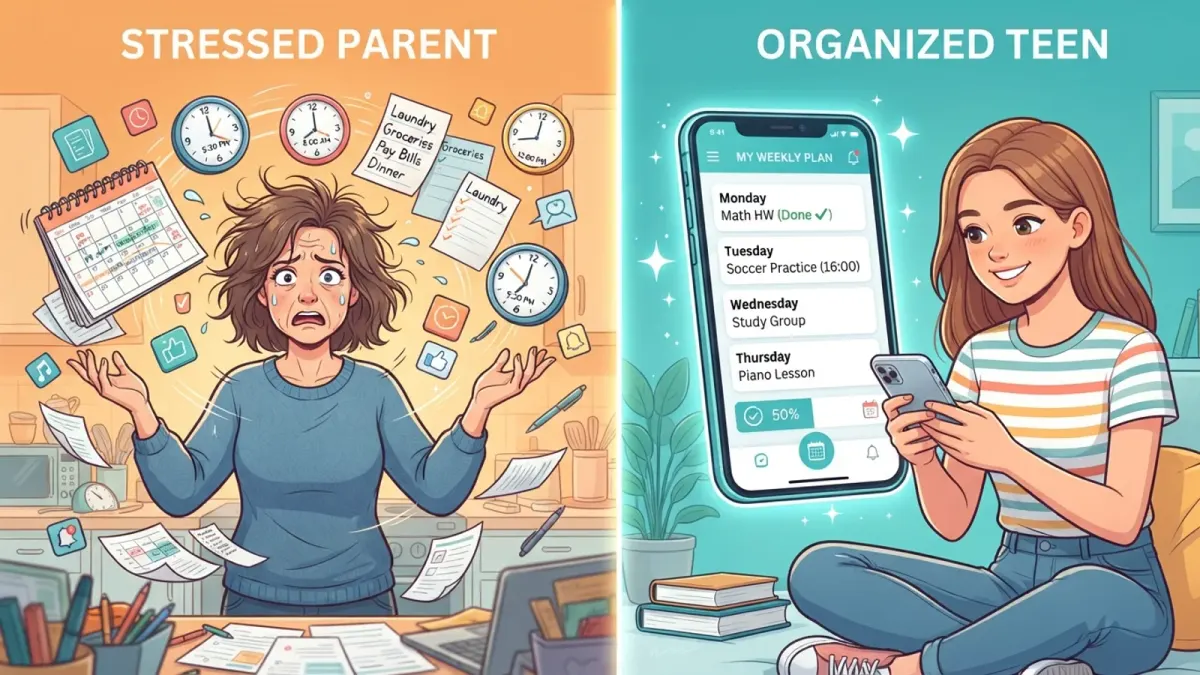
This is precisely why static, paper-based checklists on the fridge often make afternoons worse. A paper checklist cannot adapt to a child’s emotional state. It sits there, demanding compliance. Because the paper cannot speak, the parent must step in to monitor, remind, and police progress. This constant oversight breeds power struggles and friction. In contrast, predictable, self-guided routines reduce uncertainty and help kids regulate their emotions [3]. The key is shifting the delivery of the routine from a parent’s voice to an objective, interactive system.
The Anatomy of a Low-Friction After-School Routine for Kids
A successful after school routine for kids is not a race to finish homework as quickly as possible. It is a carefully paced transition that honors their emotional and physical limits. A balanced afternoon routine should be divided into three distinct, low-friction phases.
Phase 1: The “Soft Landing” (First 30 Minutes)
The first half-hour after arriving home should be entirely free of academic or household demands. The focus here is physical and emotional decompression.
- Hydration and Nutrition: Address physical depletion immediately. A pre-planned, nutrient-rich snack and a full glass of water should be waiting.
- Sensory Downtime: Allow for quiet, unstructured downtime. This might mean laying on the couch, listening to music, playing quietly with toys, or simply staring at the ceiling. There should be zero expectations during this window.
Phase 2: The Self-Guided Check-In
Once physical and emotional reserves are partially replenished, the child transitions from pure decompression to light, self-guided responsibility. This is the moment they check their daily schedule independently. By giving them a sense of control over what comes next, you reduce defensive reactions and foster autonomy. They aren’t being told what to do; they are actively discovering their own afternoon roadmap.
Phase 3: Focused Productivity
Only after the nervous system has settled and basic needs are met should you introduce focused productivity. This block is dedicated to homework, backpack organization, and preparing for the next day. Keep the environment quiet, predictable, and free of distractions to help them maintain focus without feeling overwhelmed.
How to Build an Automated After-School Schedule Template in Home Run
Transitioning from a rigid paper checklist to a dynamic, automated system is simple with Home Run. By utilizing your private family AI, you can build a customized after school schedule template that runs on autopilot, guiding your child through their afternoon step-by-step.
Step 1: Setting Up Smart Triggers
Instead of you watching the clock or waiting by the door to start the routine, let smart home routine automation handle the initiation. You can connect Home Run to smart home sensors—such as a smart lock, a front door contact sensor, or a geofence that detects when your child’s school bus arrives.
When the sensor triggers, Home Run automatically launches the “Welcome Home” sequence. This might gently illuminate the entryway lights, cast a welcoming message to a kitchen tablet, or prepare the family AI to assist them.
Step 2: Designing the Low-Demand Checklist
Within the Home Run app, design a dynamic checklist that respects the “Soft Landing” phase. Traditional checklists show everything at once, which can feel incredibly overwhelming to an exhausted child. In Home Run, you can set up sequential tasks that unlock gradually.
Start with 2-3 low-demand, high-reward tasks:
- Kick off shoes and hang up backpack (a simple physical transition).
- Enjoy your afternoon snack (Home Run can display what snack is prepared for them today).
- 20 minutes of quiet decompression time (complete with an automated visual timer).
Only after these initial decompression steps are checked off will Home Run dynamically display the higher-demand tasks, such as homework or packing their backpack for tomorrow.
Step 3: Activating Voice Commands for Autonomy
To truly remove yourself from the “nagging” loop, enable voice interactions. When your child walks into the kitchen, they don’t have to look at a screen or ask you what they should do. They can simply ask, “AI, what’s my snack and routine today?”
Home Run’s private family AI will respond in a warm, neutral tone: “Welcome home! Today’s snack is apple slices with peanut butter. After your snack, you have 20 minutes of quiet time before we check in on math homework.”
This shifts the dynamic entirely. The child is initiating the interaction, taking ownership of their schedule, and receiving information from a neutral, non-judgmental assistant rather than an exhausted parent.
How to Get Kids to Do Homework Without Nagging
The ultimate goal of automating your afternoon routine is to transform your relationship with your child during these high-stress hours. You want to know how to get kids to do homework without nagging, and the secret lies in shifting your role from behavioral enforcer to emotional ally.
Letting the AI Hold the Boundary
When a parent says, “Turn off the TV and start your homework,” it often feels like a personal attack to a tired child, leading to defensiveness and arguments. But when the smart routine dictates it is time to transition, the reminder comes from the Home Run system.
A gentle chime or a voice prompt from the AI stating, “Decompression time is complete. It’s time to open your math folder,” acts as an objective, neutral boundary. Because the system is holding the boundary, your child’s frustration is directed at the routine, not at you. You are no longer the “bad guy” enforcing the rules; you are simply a bystander in a pre-established, predictable system.
Reclaiming Your Role as the Safe Harbor
With Home Run managing the schedule, tracking progress, and delivering reminders, you can step away from micromanaging. This frees up your emotional energy.
Instead of standing over them pointing out mistakes or counting down the minutes, you can use this energy to offer connection and comfort. Sit nearby with a cup of tea, read a book, or offer quiet parallel support while they work. If they struggle or feel frustrated, you can step in as their ally: “I see this math sheet is really tough today. Let’s take a deep breath together. How can we tackle this first problem?”
By offloading the logistics to your private family AI, you preserve your evening peace and remain the safe emotional harbor your child desperately needs after a long day of self-regulation.
Restoring Peace to Your Afternoons
The transition from a highly structured school environment to the freedom of home is one of the most challenging parts of a child’s day. By replacing rigid, parent-enforced paper checklists with a dynamic, self-guided routine powered by Home Run, you remove the friction that triggers after-school restraint collapse.
Open your Home Run app tonight, navigate to the Routines tab, and set up a simple “Welcome Home” trigger. Start by adding just two low-demand steps—a snack check-in and 20 minutes of quiet time—to experience how offloading the transition to your private family AI immediately restores peace to your afternoons.